
OpenAI API Models#
In general, LMQL supports all models available via the OpenAI Completions or OpenAI Chat API, e.g., GPT-3.5 variants, ChatGPT, and GPT-4.
Specifically, we have tested the following models, with the corresponding model identifier to be used in the LMQL from clause:
openai/text-ada-001openai/text-curie-001openai/text-babbage-001openai/text-davinci-00[1-3]openai/gpt-3.5-turboalso available aschatgptopenai/gpt-4also available asgpt-4
Additionally, LMQL supports Azure OpenAI models. To learn more, please refer to the Azure API Models section.
Configuring OpenAI API Credentials#
If you want to use OpenAI models, you have to configure your API credentials. To do so you can either define the OPENAI_API_KEY environment variable or create a file api.env in the active working directory, with the following contents.
openai-org: <org identifier>
openai-secret: <api secret>
For system-wide configuration, you can also create an api.env file at $HOME/.lmql/api.env or at the project root of your LMQL distribution (e.g. src/ in a development copy).
Monitoring OpenAI API use#
When working with OpenAI models, it is important to keep track of your API usage. LMQL offers a couple of ways to see what is happening internally and how many API calls are being made.
Playground#
In the playground in the bottom right of the query editor, you can see real-time query statistics, including no. of requests, tokens and estimated cost when using OpenAI models:
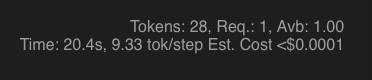
This information is automatically updated as your query is being executed. If you want to see the same information in Python, you can use the following snippet.
OpenAI Usage Statistics in Python#
To obtain the same information in Python, you can use the following snippet:
from lmql.runtime.bopenai import get_stats
print(get_stats())
# OpenAI API Stats: 1 requests, 0 errors, 9 tokens, 1.0 average batch size
The tokens metric here refers to the number of tokens that were consumed and generated by the model.
API Request Logging#
Additionally, you may be interested in seeing the actual API requests that are made in the background. To show these, there is a decoder option chatty_openai=True, which enables verbose logging and will print all OpenAI request payloads console, e.g. a query like this:
argmax(chatty_openai=True) "Hello[WHO]" from "openai/text-ada-001" where STOPS_AT(WHO, "\n")
Configuring Speculative OpenAI API Use#
To integrate the OpenAI API with LMQL, we rely on speculative prediction, where LMQL applies token masking and stopping conditions less eagerly, to save API calls.
To achieve this, output is generated in chunks, where each chunk is verified to satisfy the constraints before generation continues. The chunk size can be configured by passing openai_chunksize parameter in the decoding clause like so:
argmax(openai_chunksize=128)
    "The quick brown fox jumps over the[COMPLETION]"
from
    "openai/text-ada-001"
where
    STOPS_AT(COMPLETION, ".")
By default, the chunk size is set to 32. This value is chosen based on the consideration, that a very large chunk size means that LMQL potentially has to discard many generated tokens (which is expensive), if a constraint is violated early on. However, if a query has few or only stopping phrase constraints, a larger chunk size may be beneficial for overall query cost. In general, if a query requires multiple long, uninterrupted sequences to be generated without imposing many constraints, a larger chunk size is recommended.
OpenAI API Limitations#
Unfortunately, the OpenAI API Completions and Chat API are severely limited in terms of token masking and the availability of the token distribution per predicted token. LMQL tries to leverage these APIs as much as possible, but there are some limitations that we have to work around and may affect users:
The OpenAI Completion API limits the number of possible logit biases to 300. This means, if your constraints induce token masks that are larger than 300 tokens, LMQL will automatically truncate the token mask to the first 300 tokens. This may lead to unexpected behavior, e.g., model performance may be worse than expected as the masks are truncated to be more restrictive than necessary. In cases where the 300 biases limit is exceeded, LMQL prints a warning message to the console, indicating that the logit biases were truncated.
The OpenAI Completions API only provides the top-5 logprobs per predicted token. This means that decoding algorithms that explore e.g. the top-n probabilities to make decisions like beam search, are limited to a branching factor of 5.
The OpenAI Chat API does not provide any way to mask tokens or obtain the token distribution (ChatGPT, GPT-4). Simple constraints can still be enforced, as the LMQL runtime optimizes them to fit the OpenAI API. However, more complex constraints may not be enforceable. In these cases, LMQL will print a error message to the console. As a workaround users may then adjust their constraints to fit these API limitations or resort to post-processing and backtracking. Scripted prompting, intermediate instructions and simple constraints are still supported with Chat API models, nonetheless.